Bryce Canyon, Capitol Reef, Canyonlands, Arches, and Zion offer some of the darkest night skies in the United States. Here’s where to experience them.
Last night, I left camp and headed to a spot in Capitol Reef National Park where I could get a good view of the stars on a clear night. I was taken aback by the sheer volume of stars overhead. I have never seen so many. To be honest, I did not know it was even possible to see that many with the naked eye.
But in Southern Utah, you can.
Southern Utah is home to several of the best dark sky parks in the United States.
The region’s national parks protect some of the darkest skies in North America, making them incredible places for stargazing. The landscape is vast, remote, and dry. Cities are far apart, and much of the region is protected public land. When the sun drops behind the desert cliffs and mesas, the darkness settles in quickly.
Within minutes, the sky fills with stars.
On clear, moonless nights, the Milky Way becomes visible to the naked eye. Constellations appear sharp and bright. Planets stand out clearly against the black desert sky. Several of Utah’s national parks are officially recognized as International Dark Sky Parks, meaning they actively protect natural darkness and reduce artificial light to help visitors experience the night sky much as it once appeared across the American West.
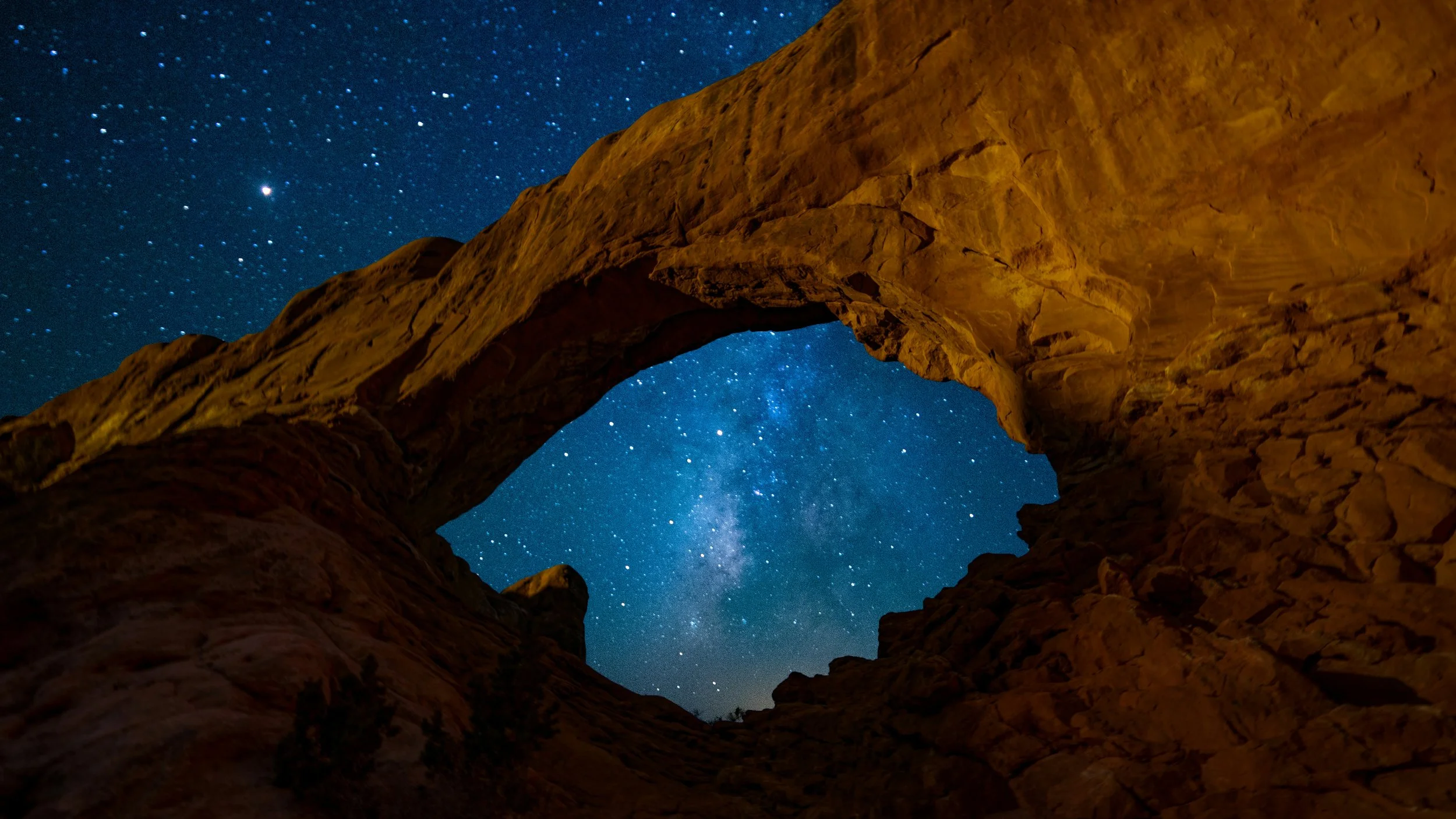
Milky Way framed by a sandstone arch in Arches National Park — photo by Tom Gainor on Unsplash.
Why You Can See So Many Stars in Southern Utah
One of the main reasons the night sky looks so dramatic in southern Utah is low light pollution.
Light pollution comes from artificial lighting in cities, towns, highways, and buildings. That light scatters in the atmosphere and brightens the night sky, making it difficult to see faint stars.
In large cities, only a few dozen stars may be visible.
In remote places like southern Utah, thousands of stars become visible because there is very little artificial light. The region is sparsely populated, much of the land is protected public space, and the dry desert air helps keep the sky clear.
Because of these conditions, parks like Bryce Canyon National Park, Capitol Reef National Park, Arches National Park, Canyonlands National Park, and Zion National Park are recognized as some of the best places in North America to experience a truly dark night sky.
Bryce Canyon National Park
Bryce Canyon is widely considered one of the best places in the United States for stargazing.
The park sits between 8,000 and 9,000 feet in elevation, which means thinner air and extremely clear visibility. Combined with the park’s remote location, it produces some of the darkest skies in the country.
The hoodoos of the Bryce Amphitheater create an incredible foreground for night photography. Under starlight, the pale rock formations glow softly while the sky fills with thousands of stars.
On moonless nights, the Milky Way becomes clearly visible across the canyon.
Stargazing locations
• Inspiration Point
📍 37.6121° N, 112.1677° W
Inspiration Point sits high above the Bryce Amphitheater and offers one of the widest views in the park. From this elevation, you can see across the entire hoodoo-filled basin, which creates a dramatic foreground beneath the stars.
• Sunset Point
📍 37.6225° N, 112.1677° W
Sunset Point sits directly along the rim of the Bryce Amphitheater and provides unobstructed views across the hoodoos. At night, the rock formations appear as dark silhouettes beneath the star-filled sky.
• Bryce Amphitheater overlooks
📍 37.6229° N, 112.1676° W
The Bryce Amphitheater is the park’s most famous landscape feature. Multiple overlooks along the rim provide excellent places to watch the stars once darkness settles over the canyon.
Capitol Reef National Park
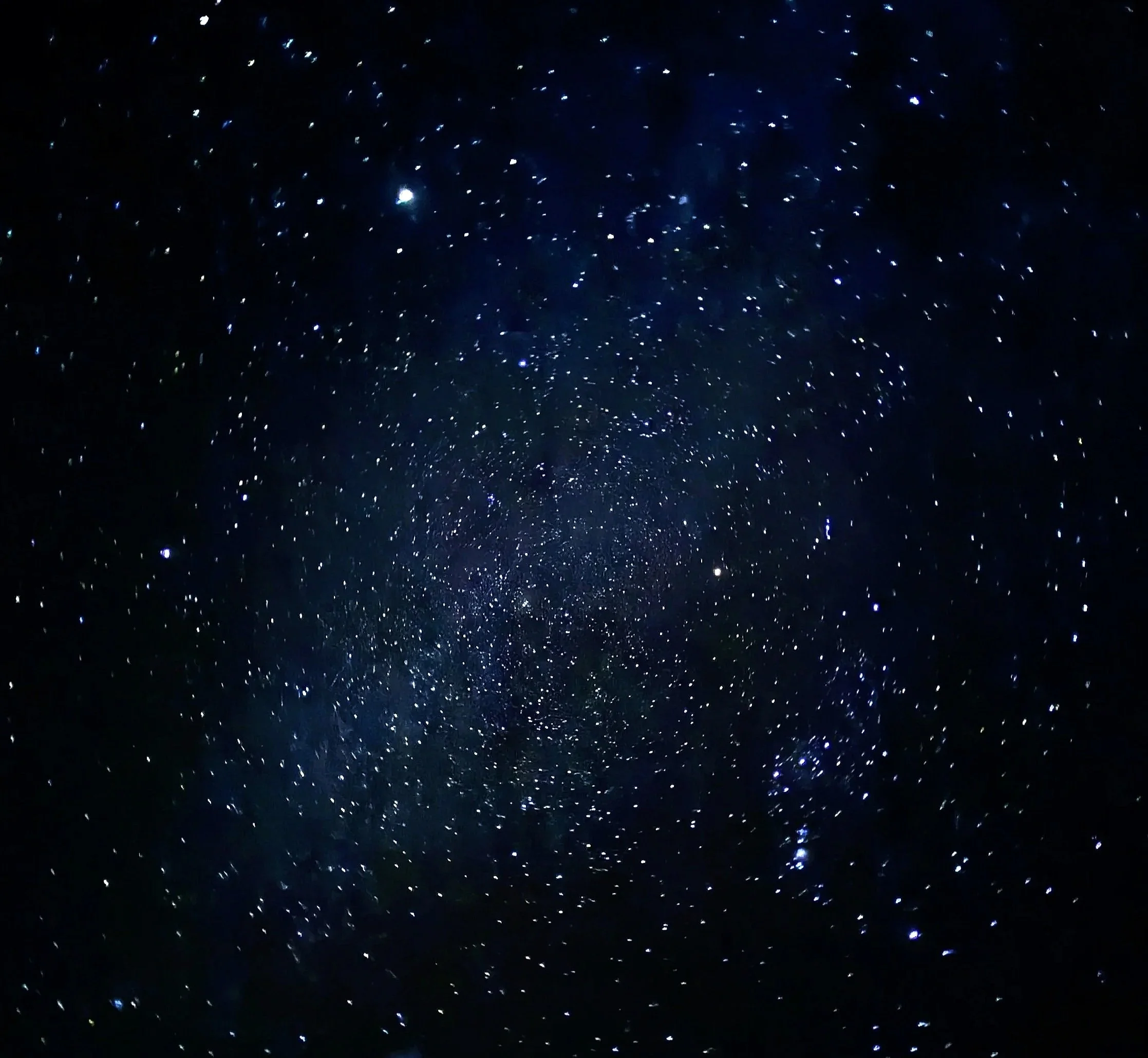
My first attempt at photographing the night sky in Capitol Reef National Park using my iPhone and a tripod while waiting for the sky to get as dark as possible.
Capitol Reef is one of Utah’s least visited national parks, and that remoteness makes it an excellent place to experience the night sky.
Designated an International Dark Sky Park in 2015, the park sits far from major cities and large towns. Once night falls, the desert becomes incredibly quiet and dark.
I drove up to Panorama Point to photograph the stars.
The overlook sits above the desert landscape with wide views in nearly every direction. After dark, the cliffs and ridges fade into the background, and the sky becomes the focus.
Standing there, away from town lights and traffic, the number of visible stars is staggering. Constellations become easier to pick out, and on clear nights, the Milky Way stretches across the horizon.
Stargazing locations
• Panorama Point
📍 38.2966° N, 111.2619° W
Panorama Point sits above the desert landscape with wide views in nearly every direction. The open horizon makes it an excellent place for photographing the Milky Way.
• Goosenecks Overlook
📍 38.2917° N, 111.2613° W
This overlook sits above a winding canyon carved by Sulphur Creek. The dark canyon below creates a striking contrast with the stars overhead.
• Fruita Campground
📍 38.2881° N, 111.2477° W
The Fruita district sits far from city lights, making it a surprisingly good place to watch the stars directly from camp.
Arches National Park
Arches National Park became an official International Dark Sky Park in 2019.
Although the park sits near the town of Moab, the landscape quickly becomes darker as you move deeper into the desert. Massive sandstone formations create striking silhouettes beneath the stars, making Arches one of the most visually dramatic places in Utah for night photography.
Many visitors leave the park after sunset, which means the roads and overlooks often become quiet once darkness settles in.
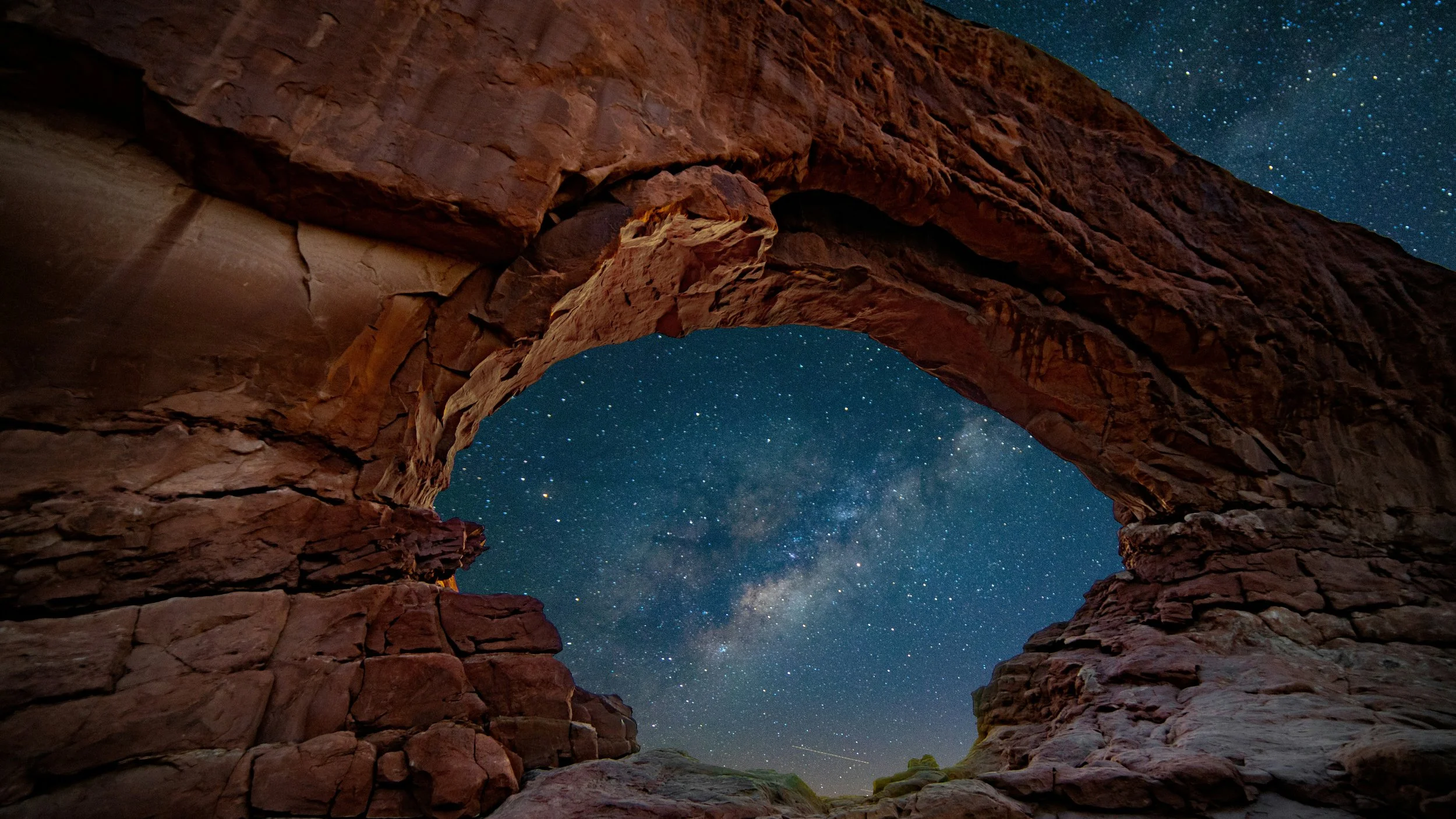
Stars and the Milky Way over a sandstone arch in the Windows area of Arches National Park — photo by Tom Gainor on Unsplash.
Stargazing locations
• Balanced Rock
📍 38.5966° N, 109.5620° W
Balanced Rock sits along the main park road and is easy to reach after dark. The towering rock formation creates a strong foreground silhouette against the night sky.
• Park Avenue Viewpoint
📍 38.5976° N, 109.6069° W
This viewpoint looks down a dramatic corridor of tall sandstone walls. At night, the canyon opens toward the sky, making it a good location for wide Milky Way shots.
• The Windows Section
📍 38.6893° N, 109.5325° W
The Windows area contains several large arches that work well as foreground elements in night photos. The open desert landscape allows for wide views of the sky.

Balanced Rock silhouetted beneath the Milky Way in Arches National Park — photo by Tom Gainor on Unsplash.
Zion National Park
Zion National Park earned its International Dark Sky Park designation in 2021.
Because much of Zion sits within a deep canyon, the experience of the night sky here can feel different from that in Utah's open desert parks. In some areas, towering sandstone walls block parts of the sky.
For broader views of the stars, it helps to head to locations where the landscape opens up and the horizon is wider.
Stargazing locations
• Canyon Junction Bridge
📍 37.2131° N, 112.9873° W
This is one of the most photographed locations in the park. From the bridge, you can see The Watchman rising above the Virgin River, which creates a dramatic foreground for night photography.
• Checkerboard Mesa
📍 37.2236° N, 112.8797° W
Located on the east side of the park, this area has a more open landscape and fewer canyon walls blocking the sky. The patterned sandstone formation also makes an interesting foreground for star photos.
• Kolob Terrace Road
📍 37.3253° N, 113.0767° W
This road climbs onto a higher plateau where the terrain opens up and the sky becomes much larger. Pullouts along the road provide darker skies and excellent stargazing opportunities.
How to Photograph the Stars With Your Phone
You don’t need expensive camera gear to photograph the night sky. Many modern phones can capture stars surprisingly well.
The most important piece of gear is a tripod.
When photographing stars, the camera shutter stays open longer to collect light. If the phone moves even slightly, the photo will blur. A tripod keeps the camera completely still while the image is taken.
I used a simple tripod I bought on Amazon. It’s not fancy or expensive, but it worked well for capturing the stars.
Tripod I used → VICTIV 74” Camera Tripod, Tripod for Camera and Phone, Aluminum Professional Tripod Stand
Once your phone is steady, the next step is knowing where to point your camera.
Use a Night Sky App
Most photographers use an app to see where stars and the Milky Way will appear in the sky. I did not know this the first time because I didn’t realize these apps existed.
Two popular options are PhotoPills and Stellarium. These apps show exactly where the Milky Way, constellations, and planets will be based on your location and time of night.
I downloaded Skyguide.
You can hold your phone up to the sky, and the app will overlay the star positions, helping you aim your camera in the right direction.
Look for the Milky Way
On clear nights in southern Utah, the Milky Way often appears as a faint, cloudy band stretching across the sky. Once you spot it, that’s usually the best direction to point your camera.
Places like Panorama Point work well because the horizon is wide and unobstructed.
Pro Tip: In extremely dark places like southern Utah, your camera will capture far more stars than your eyes can see. Even if the sky looks relatively dark to you, a long-exposure photo can reveal thousands of stars and the Milky Way.
Field Note: My Favorite Dark Sky Moment in Utah
Location: Capitol Reef National Park
Spot: Panorama Point
I was sitting in my van waiting for the sky to get as dark as it possibly could. It was interesting to watch it happen in phases as the last light slowly disappeared from the horizon.
Once it finally reached full darkness, I stepped outside and looked up.
I could not believe the number of stars overhead. There were stars on top of stars. I had never seen anything like it before. I didn’t know it was even possible to see that many stars with the naked eye.
It was an amazing and unbelievable sight.
Other Dark Sky Places in Utah
Utah’s dark skies extend beyond the national parks. Several other protected areas also offer exceptional stargazing.
• Dead Horse Point State Park
• Natural Bridges National Monument
• Goblin Valley State Park
These locations receive fewer visitors than the national parks and can offer equally impressive night skies.
When to See the Best Stars in Utah
A few conditions make a big difference when planning a night of stargazing.
Moon phase
The darkest skies occur during a new moon or when the moon sets early.
Clear desert air
Southern Utah’s dry climate often produces excellent visibility.
Distance from towns
The farther you move away from populated areas, the darker the sky becomes.
Late spring through fall typically offers the most comfortable nighttime temperatures for spending time outdoors.
Experiencing Utah’s Night Sky
Southern Utah holds some of the darkest protected skies in North America.
Out here, the stars feel closer than they do in most places. Without the glow of city lights, the night sky becomes incredibly detailed. The Milky Way stretches across the horizon, satellites glide slowly overhead, and constellations appear sharper than most people ever see.
In places like southern Utah, the night sky still looks the way it did long before cities and electric lights.
Michele Underwood writes Overland Girl, where she shares firsthand travel experiences across the American West — from desert landscapes and national parks to small towns layered with history. Her work blends movement, place, and the stories that shape them.

Some posts may include affiliate links to products or services she uses on the road. If you choose to purchase through those links, she may earn a small commission at no additional cost to you. It helps support continued travel and storytelling. She only links to items she personally uses or would use herself.