Ouray, Colorado: Why This Mountain Town Is So Special
The mining history, mountains, and little details that make
Ouray unlike anywhere else I've been in Colorado.
Words by Michele Underwood | Photos by Michele
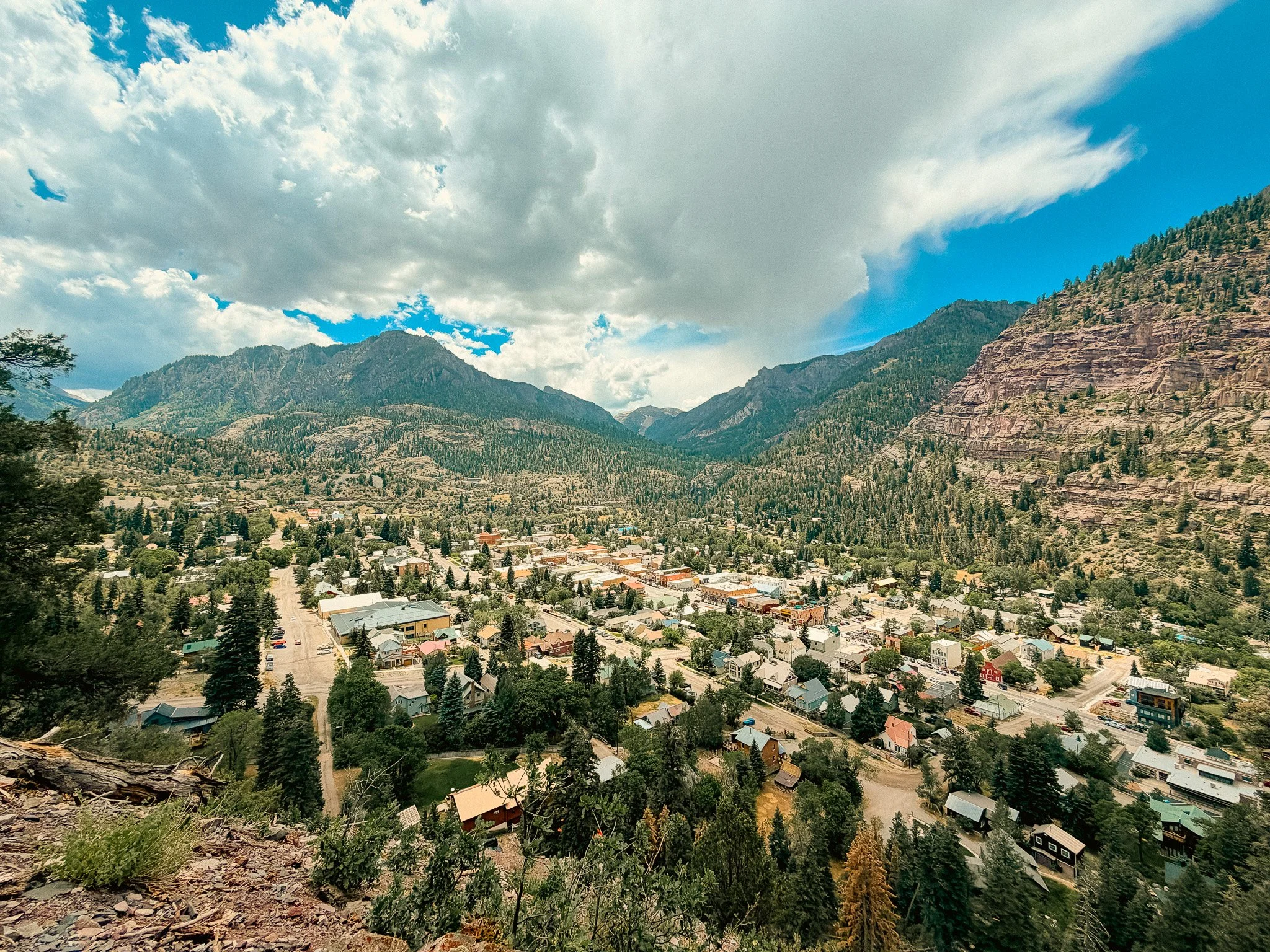
Looking down over downtown Ouray from the Perimeter Trail, with the San Juan Mountains rising around town.
I've been in this part of Colorado for more than two months now, staying around Ridgway and spending a lot of time in Ouray. I've come over to hike, walk around town, and, of course, drive the Million Dollar Highway from here to Silverton.
The more time I've spent in Ouray, the more I've come to like it.
It's a small town, but the mountains around it make it feel like you're tucked into this little pocket of the San Juans. You don't have to go looking for the scenery. It's right there. There are waterfalls coming down the mountainsides, hiking trails you can pick up around town, and old buildings along Main Street that give you a pretty good clue that Ouray has been here for a while. You can even see old mining artifacts on the mountainside along the road as you drive into downtown Ouray.
One of the things I love most about Ouray is all the mining history that's still here and scattered throughout the mountains around it. I think it's so cool to be driving or hiking and see an old mine sitting on a mountainside, or come across buildings that are still standing from that time.
After spending so much time here, I wanted to know more about it. Why was a town built in this particular spot? What brought people here in the first place? And why did Ouray survive when so many of Colorado's old mining towns didn't?
As it turns out, a lot of what I like about Ouray today goes back to what happened here more than a century ago.
What Is Ouray, Colorado Known For?
Today, Ouray is probably best known for its setting in the San Juan Mountains, its hot springs, waterfalls, hiking, and the Million Dollar Highway that runs south out of town toward Silverton. It's also known as the "Switzerland of America," a nickname that makes a lot more sense once you're standing here looking at the mountains surrounding town.
But Ouray didn't begin as a mountain vacation town.
Mining brought people here in the 1870s, and Ouray grew into an important supply center for the mines scattered throughout the surrounding mountains. The town that visitors walk through today grew out of that mining boom.
Once you know that, you start noticing the history everywhere.
I've seen old mining structures while driving the Million Dollar Highway, and remnants of that time are scattered throughout the mountains around Ouray. Even some of the routes people now use to hike and explore these mountains have connections to the mines that once operated here.
And then there is the name itself. Ouray is pronounced YOU-ray. I work at a local bookshop on the weekends, and people ask me how to pronounce Ouray all the time. I always tell them I made the same mistake when I first got here.
Mining Shaped the Ouray I See Today
Ouray was established in 1875 and incorporated the following year as prospectors poured into the San Juans searching for gold and silver.
But its location gave it a role beyond simply being another mining camp.
Mines were scattered high in the mountains, and everyone working in them needed food, tools, equipment, and other supplies. Ouray became an important place for getting those supplies into the surrounding mining districts.
Stores opened. Hotels, homes, saloons and churches were built. Businesses developed around the needs of miners and everyone else who came here because of the mining boom.
By the late 1800s, Ouray had grown into an established town. Many of the historic buildings you see around town today date back to this period, which is one reason walking around downtown still feels connected to the town's past.
What I find especially interesting is how far beyond town that connection reaches. The mines weren't all sitting right outside Ouray. Mining camps and operations were scattered throughout some incredibly rugged country in the San Juan Mountains, and all of those places still needed supplies.
Ironton, farther up toward Red Mountain Pass, became an important transportation and supply point for the mines in the Red Mountain Mining District. Supplies coming from Ouray traveled up into the mountains, while ore made the trip in the opposite direction.
The Yankee Girl Mine was part of that larger Red Mountain mining district.
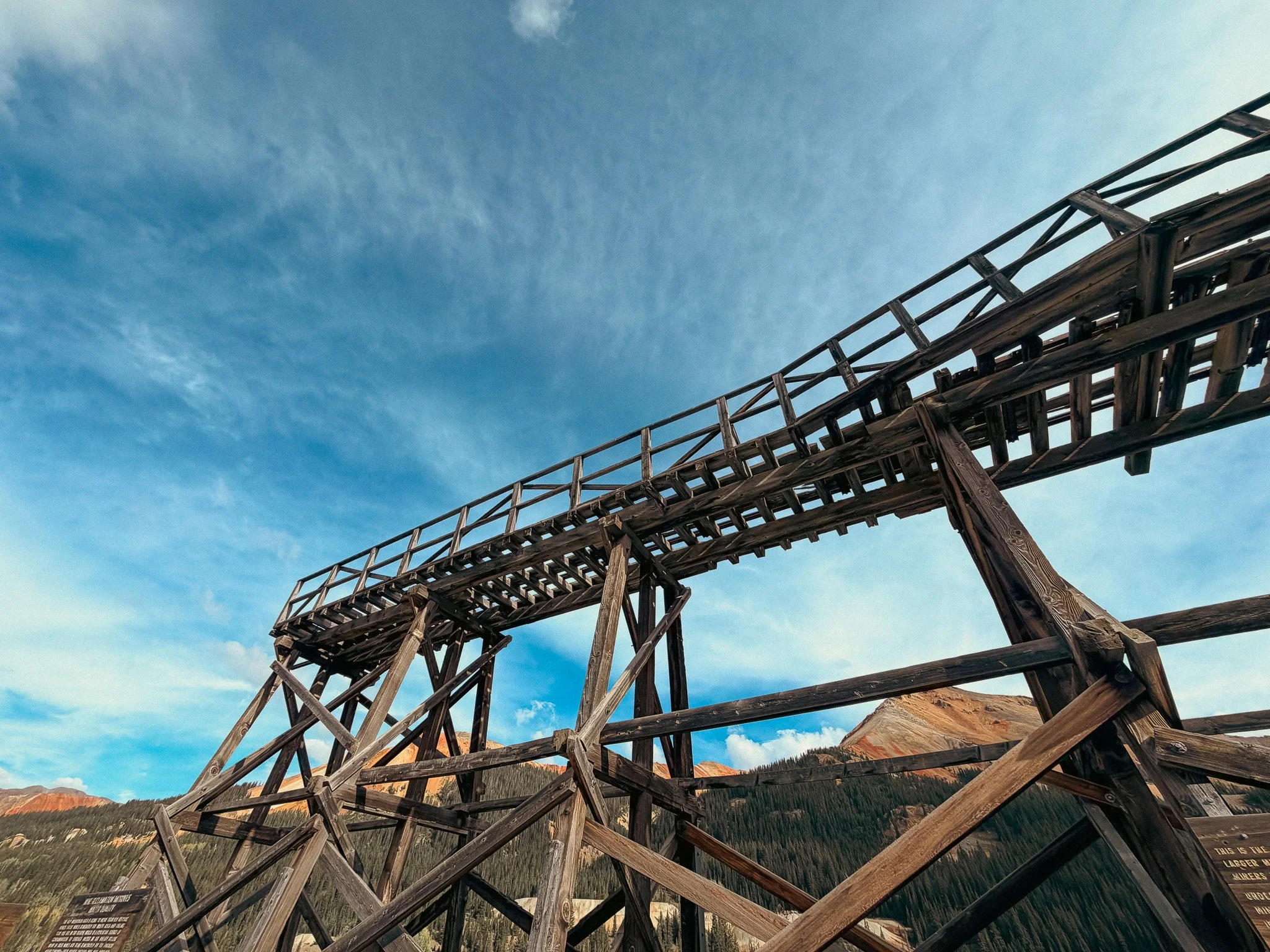
The old tram structure at the Yankee Girl Mine, one of the most recognizable mining landmarks along the Million Dollar Highway.
Today, you can still see the Yankee Girl headframe when you drive the Million Dollar Highway between Ouray and Silverton. Once you know where the supplies and people working these mines came from, the relationship between the highway, the old mines, and Ouray becomes much easier to understand.
That's the part I really like. These aren't just names I'm reading about. I can drive up the Million Dollar Highway and see the Yankee Girl headframe. I can stop at Ironton and walk around what remains of the town. The mining history is still right there.
I've also been seeing that history from a completely different direction because I've been camping at Angel Creek Campground off Camp Bird Road, just outside Ouray. I originally came up this way because of the hiking and access farther into the mountains toward Yankee Boy Basin. It wasn't until I started learning more about Ouray's history that I realized I was camping right in the middle of some of its old mining country.
Camp Bird Road gets its name from the Camp Bird Mine, one of the most successful gold mines in the area. Thomas Walsh developed the mine after discovering rich gold ore here in the 1890s, and Camp Bird became one of Colorado's important gold-producing mines.
The road heads up Canyon Creek from Ouray toward the historic Camp Bird Mine area before the network of mountain roads continues farther into the San Juans. One direction leads toward the Camp Bird and Imogene Pass area, while another takes you toward Yankee Boy Basin beneath Mount Sneffels.
I drive these roads because I want to hike and explore. Knowing why the roads are here in the first place has changed the way I look at them. Long before people were heading up here for trails, camping, or Yankee Boy Basin, these routes were moving people, equipment, and supplies through the mountains.
Mining history runs through this area. Old mine and mill remains are scattered through the mountains, and the former mining settlement of Sneffels once stood farther up the road near the Camp Bird Mine.
Mining also took place on Gold Mountain near Ouray. The Bachelor Mine dates back to the mining boom, and today the Bachelor-Syracuse Mine lets visitors go underground and see part of that history for themselves.
It's one of the reasons I keep wanting to explore farther. I'll see an old structure or mine and want to know what it was, who worked there, and how it fit into everything else I'm seeing around Ouray.
The Million Dollar Highway is probably where that history becomes the most obvious.
The highway climbs south out of Ouray toward Red Mountain Pass through an area that was once filled with mining activity. Old structures still sit against the mountainsides, and the remains of mines and mining communities appear along the route, sometimes in places where it's difficult to imagine anyone building anything.
Around Red Mountain Pass, the rock takes on those reds, oranges, and yellows that make this part of the drive so beautiful. Against that landscape are pieces of the mining era that have somehow survived more than a century of San Juan winters.
That was one of my favorite parts of driving the Million Dollar Highway.
I expected the huge drop-offs and lack of guardrails I'd heard so much about. What I wasn't expecting was how much mining history I could see from the road.
I wrote more about what it was like to drive the Million Dollar Highway from Ouray to Silverton, including the drop-offs, lack of guardrails, Red Mountain Pass, and what I saw along the way. The road has enough mining history that I'm also covering the old mines and mining communities separately.
How Ouray Survived After Mining Declined
This is another part of the story I wanted to understand. So many mining towns in these mountains disappeared. Ouray didn't.
Eventually, mining slows down. Ore becomes harder or more expensive to extract, mineral prices change, and mines close. When the mine is the only reason a community exists, the town can disappear right along with it.
You can see the results all over the San Juans. Some former mining communities are now ghost towns or little more than a few structures sitting in the mountains.
Ouray survived.
Mining remained part of the area's economy for years, but the town had begun developing another reason for people to come here. People wanted to see Ouray itself.
The same landscape that made mining here so difficult eventually became one of Ouray's biggest assets. The mountains, waterfalls, and hot springs attracted visitors. Roads improved, making it easier for people to reach the town and explore the surrounding San Juans.
That's pretty much why I'm here now. I came for the mountains, hiking and exploring, but I've ended up becoming just as interested in the history I keep finding while I'm doing those things.
There are trails all around Ouray, including trails you can access right from town. Some start climbing almost immediately and give you completely different views of the valley, town, and surrounding mountains. I've written more about my favorite things to do around Ouray if you want the specifics.
And you keep running into the history.
Some of the trails and old routes through these mountains are tied to the mining era. You can be hiking for the scenery and suddenly find yourself looking at the remains of something built when people were coming into these mountains to work rather than recreate. I found that again hiking Mears Trail near Ouray, where the trail leads to the remains of the old Larson Brothers Mine.
The history isn't separate from the place I'm hiking and exploring. It's still all around it.
What Makes Ouray So Special?
After more than two months in this area, I think what makes Ouray special is how much is packed into such a small place.
The mountains don't sit somewhere off in the distance. They rise right around town. There are waterfalls coming down the mountainsides, hiking trails you can access without going far, and old mining structures still visible in the surrounding mountains.
And for me, the mining history is a big part of it. I love seeing the old buildings and mines still sitting in the mountains. The more I learn about them, the more I notice when I'm out hiking, driving, or exploring.
The "Switzerland of America" nickname makes sense to me now, too. Ouray sits at around 7,800 feet with steep mountains rising around it on nearly every side. I've spent time in a lot of Colorado mountain towns, but Ouray feels especially tucked into the mountains. You're not looking toward peaks somewhere off in the distance. You're surrounded by them.
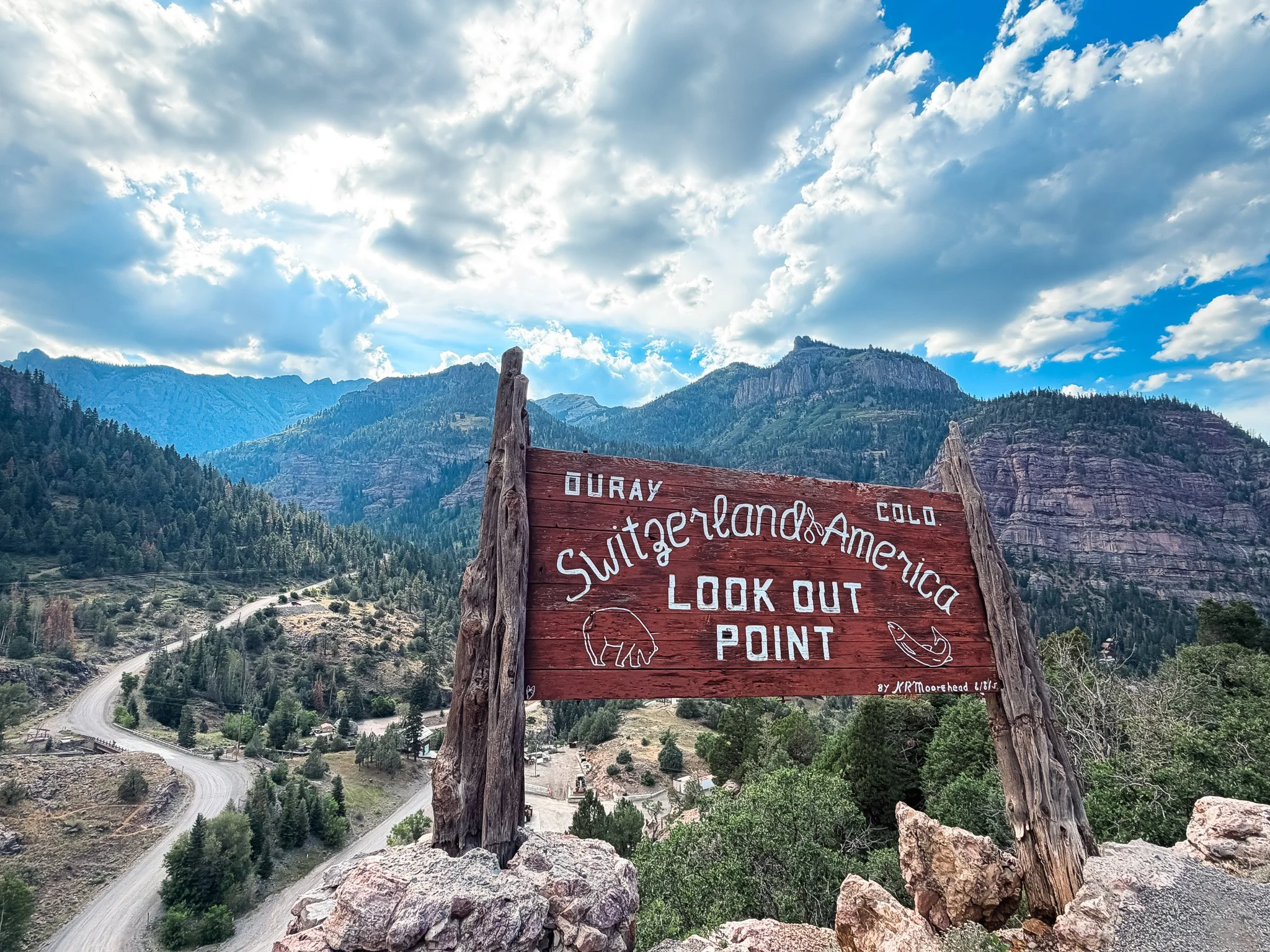
The Switzerland of America Lookout Point above Ouray, with the San Juan Mountains stretching out behind it.
And you definitely feel the elevation when you first get here. Downtown Ouray is built on a hill, so even walking up the street past the shops is uphill. When I first arrived in the area, I thought I was going to die walking up that street. Now it's easy breezy.
Drive one direction, and you're heading up Camp Bird Road toward Yankee Boy Basin. Drive south, and you're almost immediately climbing the Million Dollar Highway toward Red Mountain Pass and Silverton.
Then there is the town itself. Ouray has held onto much of its mining-era character, so the history I've been learning about isn't completely separate from the place I'm visiting today.
When I first started coming into town, I mostly noticed the mountains, waterfalls, Main Street and trails. Now I'm looking up at the mountainsides for old mines. I'm stopping at places like Ironton. I'm learning what happened along the roads I'm driving.
I think that's what has kept me coming back. I can spend one day hiking, another exploring an old mining road, another walking around town, and still feel like there is more here I haven't seen.
Ouray is beautiful, but Colorado has plenty of beautiful places.
For me, it's everything that's packed into this little valley that makes Ouray different.
I write Overland Girl, where I share firsthand travel experiences across the American West — from desert landscapes and national parks to small towns layered with history. My work blends movement, place, and the stories that shape them.Some posts may include affiliate links to products or services I use on the road. If you choose to purchase through those links, I may earn a small commission at no additional cost to you. It helps support continued travel and storytelling. I only link to items I personally use or would use myself.