Coldwater Mountain Mountain Biking: Trail Flow, Features, and Ride Feel
Words by Michele Underwood | Photos by Michele
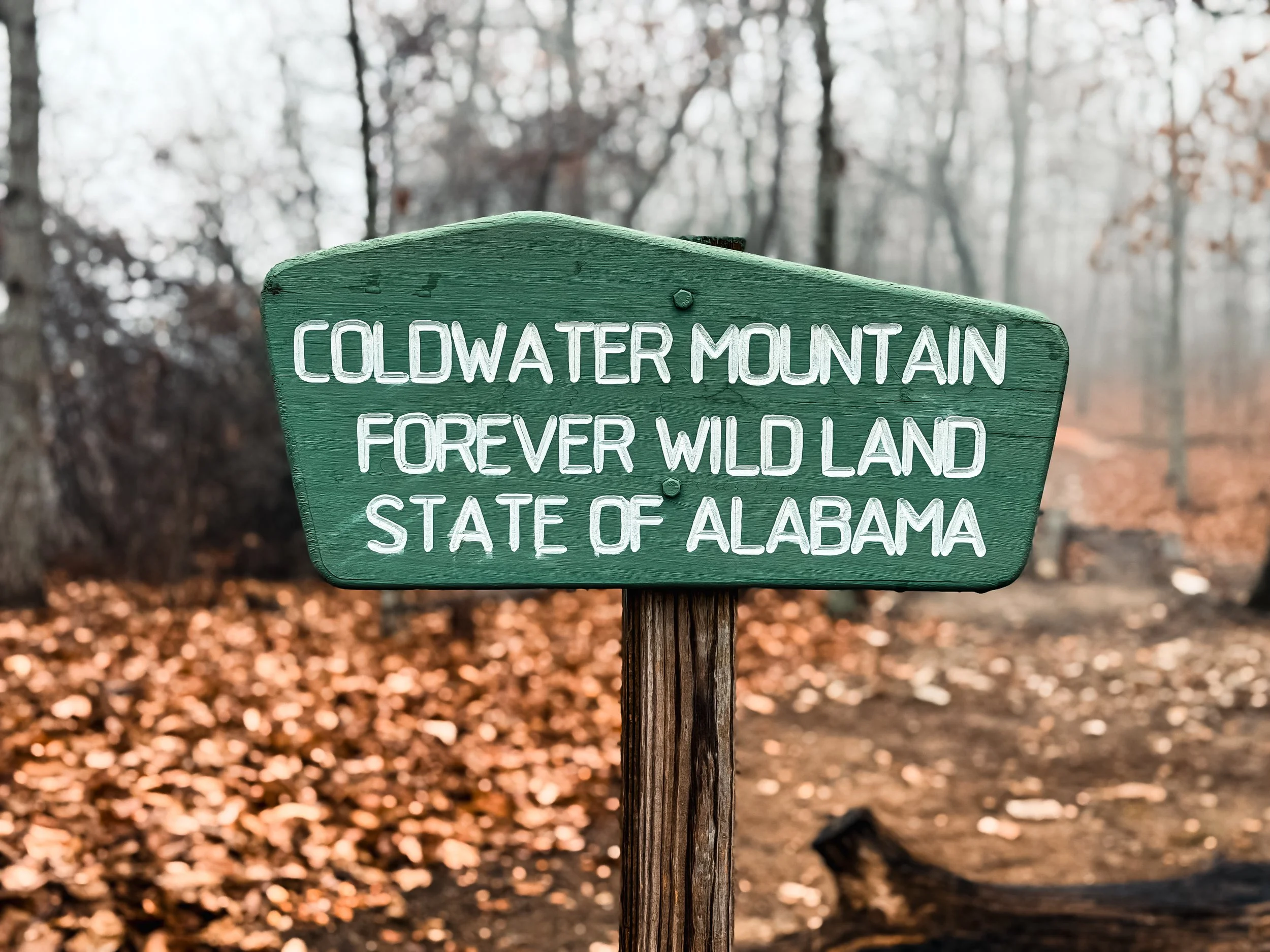
Coldwater Mountain Forever Wild Land sign marking protected trail land in Anniston, Alabama.
I’d heard of Coldwater Mountain but knew very little about it beyond a few ride videos, so I decided to spend a weekend riding the system. It’s not a small place, with roughly 56 miles of trail and about 1,532 feet of elevation gain across the network.
Coldwater Mountain Terrain and Trail Design
Coldwater Mountain sits at the southern edge of the Appalachian Mountains, where the foothills of the Blue Ridge Mountains begin to take shape. Alabama’s highest point, Cheaha Mountain, is located less than an hour away, and the shared geography shows up in the landscape here—long ridgelines, forested slopes, and sustained elevation change. The terrain is well-suited for mountain biking trail design, allowing trails to follow the natural contours of the land. That creates sustained flow, natural speed, and features that feel integrated rather than forced, with enough vertical change to keep each lap engaging.
Trail Management and Stewardship
Coldwater Mountain is located on land owned by the Forever Wild Land Trust, a subagency of the Alabama Department of Conservation and Natural Resources. The trail system is managed through a partnership between Forever Wild, the City of Anniston, and the local trail community.
In 2018, the City of Anniston created a dedicated Recreational Trail Director position to support and maintain the growing system. Trail development follows a long-term master plan developed with trail design expert Rich Edwards, and at full buildout, the system is expected to reach roughly 100 miles of trail.
The Northeast Alabama Bicycle Association (NEABA), the local SORBA chapter, has played a central role in advocacy, trail building, and securing support for the system. NEABA works closely with the City, Forever Wild, and other agencies to push new trail construction and support the long-term vision for Coldwater.
Riding Coldwater Mountain: My POV
When I arrived Friday afternoon, I wanted an easy first ride—something close to where I was staying and a good way to get a feel for the terrain. I started on Tortoise, a green trail that climbs 2.7 miles to the top. Calling it a green doesn’t mean it’s mellow. It’s a real climb, and a rocky one. Rocks are a defining part of the terrain at Coldwater Mountain, and that’s honestly a big reason I wanted to ride here. The climbing is steady, technical in places, and immediately sets expectations for what the system is built on.
At the top, the trail opens into a hub with multiple options branching off in different directions. For that first ride, I dropped into Hare to head back toward camp. The name makes sense quickly. Hare is a green downhill trail, about 1.8 miles long, and it moves. Berms, tabletops, rollovers, and sustained flow come one after another, and it rides much faster than I expected for a green. It felt playful and confident, not overly cautious, and it was a strong first impression of how well the trails are designed.
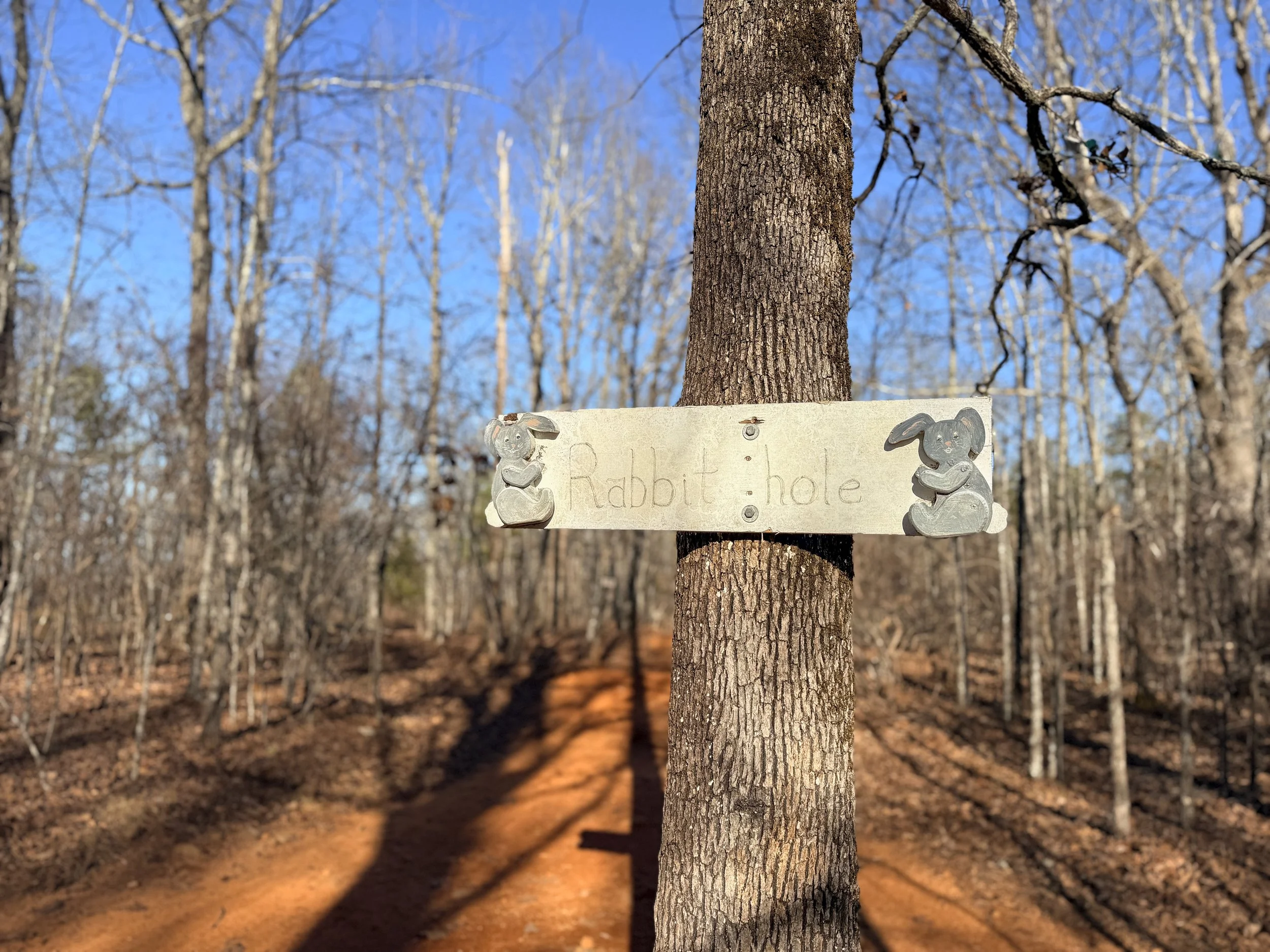
Trail marker at the Rabbit Hole hub on Coldwater Mountain, where multiple routes branch off into the system.
Saturday rode differently, in the best way. Anytime I ride a trail for the second time, it’s always better. I had a tip from a local to head toward the S Hub, also known as the Rabbit Hole, and from there ride Talladega, a blue trail. Getting there meant climbing Tortoise again, which I didn’t mind this time. It felt quicker and more familiar, less like a grind and more like part of the system's rhythm.
At the top, I met a few riders from Atlanta who were heading the same way, and I followed them toward the Rabbit Hole. We rolled along Chilhowee for a bit, which stood out as a solid connector that still feels intentional—good pacing, good flow, and not just a means to an end.
Talladega ended up being a highlight. It’s chunky in many sections, with rock that forces line choices and commitments. In places, it reminded me of riding I’ve seen in Moab—raw, technical, and rewarding when you stay engaged. It’s not sloppy or unpredictable, just honest riding that asks you to pay attention.
At the end of Talladega, I took Bull Frog, a short, efficient trail that loops back toward Chilhowee and the Rabbit Hole. From the Rabbit Hole, I needed to get back toward camp via Hare, but I had to take another trail to get there. I could have stayed on Chilhowee, which I’d already ridden earlier, but I decided to take Trillium instead.
Trillium is a short blue downhill—less than a mile—with smooth flow and small jumps you can either roll or take, depending on speed and comfort. From there, I finished on Hare again, which rides very differently once you know what to expect. Fast, berm-heavy, and clearly built with jumps in mind, it dropped me straight back into camp.
By the end of the second day, Coldwater Mountain felt less like a quick stop and more like a place you could keep coming back to. The way the trails connect, the consistency of the terrain, and the mix of flow and technical riding make it a system that rewards both exploration and repetition.
Coldwater Mountain Trailheads: Anniston vs. Coldwater
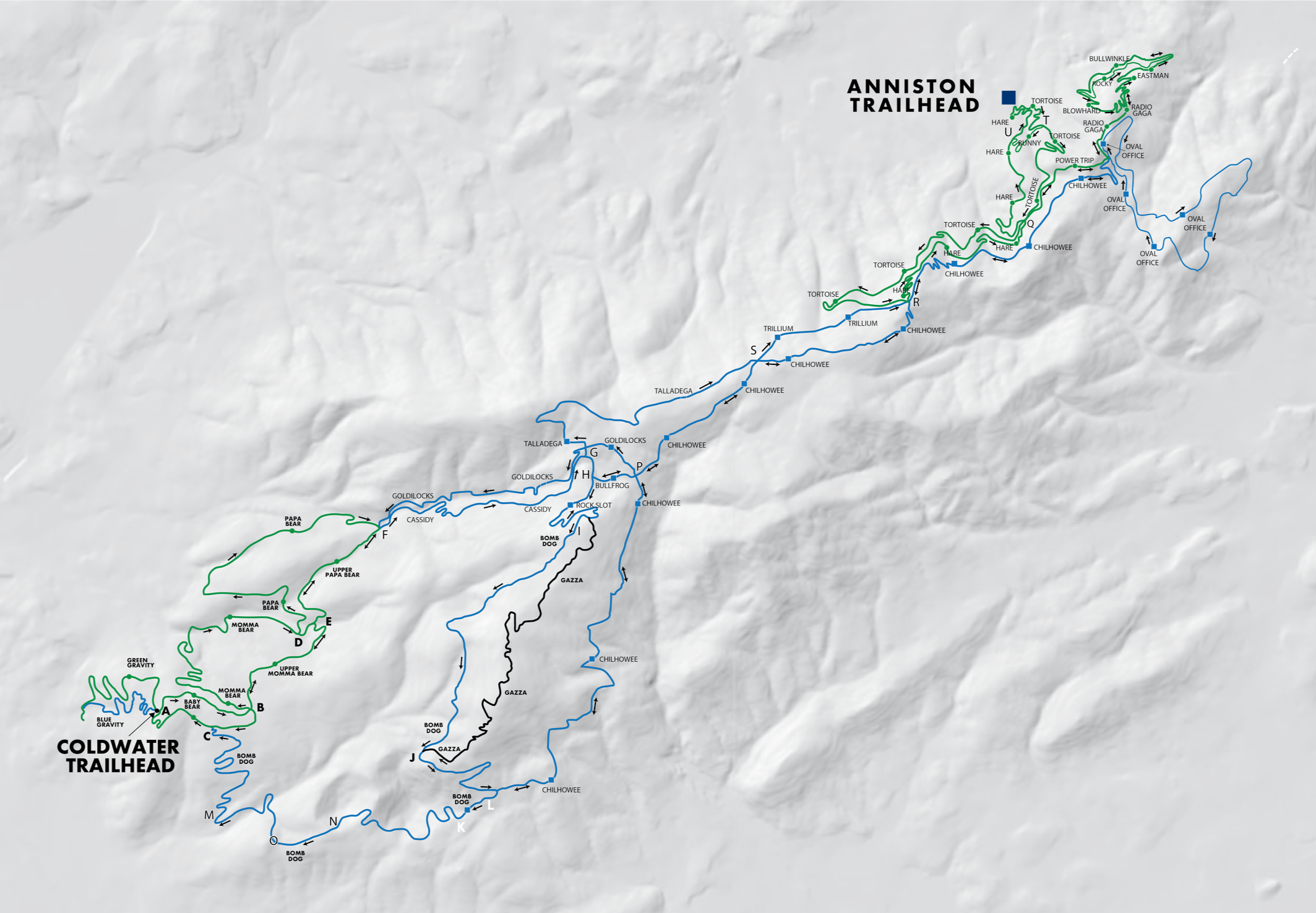
Trail map of the Coldwater Mountain mountain bike system showing the Anniston and Coldwater trailheads and how the trails connect across the mountain.
I was camping at Coldwater Camp & Cabins, which sits at the newer Anniston Trailhead. The original access point is the Coldwater Trailhead, where many of the better-known, more frequently ridden trails are located. The key difference between the two is elevation. From the Coldwater Trailhead, you’re starting higher up on the mountain, while the Anniston Trailhead puts you lower in the system with more climbing to reach the same trails.
That said, getting between the two areas is straightforward. Even starting from the Anniston Trailhead, it’s easy to connect into the main network and reach the popular trails on the Coldwater side. Trails like Goldilocks and Bomb Dog are over there and are often mentioned when people talk about Coldwater, but they’re still accessible without needing to relocate or shuttle.
I tend to like working my way through a trail system over time rather than chasing only the highlights, and Coldwater feels like a place that rewards that approach. Between the two trailheads, there’s plenty to explore, and how you choose to enter the system can shape how each ride feels.
Trail Difficulty Reality Check at Coldwater Mountain
Trail ratings at Coldwater Mountain are best understood in context. The system is graded relative to itself, not as a direct comparison to trail networks elsewhere. Because of that, even green trails here ride more challenging than greens at many other destinations.
Green trails often include sustained climbing, rocky tread, and technical elements that require balance and line choice. For a brand-new mountain biker, these trails would likely feel challenging, especially over longer distances.
Blue trails step up quickly, with more rock density, faster speeds, and features that assume confidence on uneven terrain. Black trails lean fully into commitment, speed, and consequence and are best approached once you understand how the system rides overall.
Rock-Driven Terrain
The defining feature of Coldwater Mountain is its rocky terrain. Full rock gardens, long chunky sections, and constant small rock litter are part of nearly every trail. Very few stretches are pure dirt. Even the smoother, flow-focused trails are built on top of rock, which keeps the riding technical and engaging from start to finish.
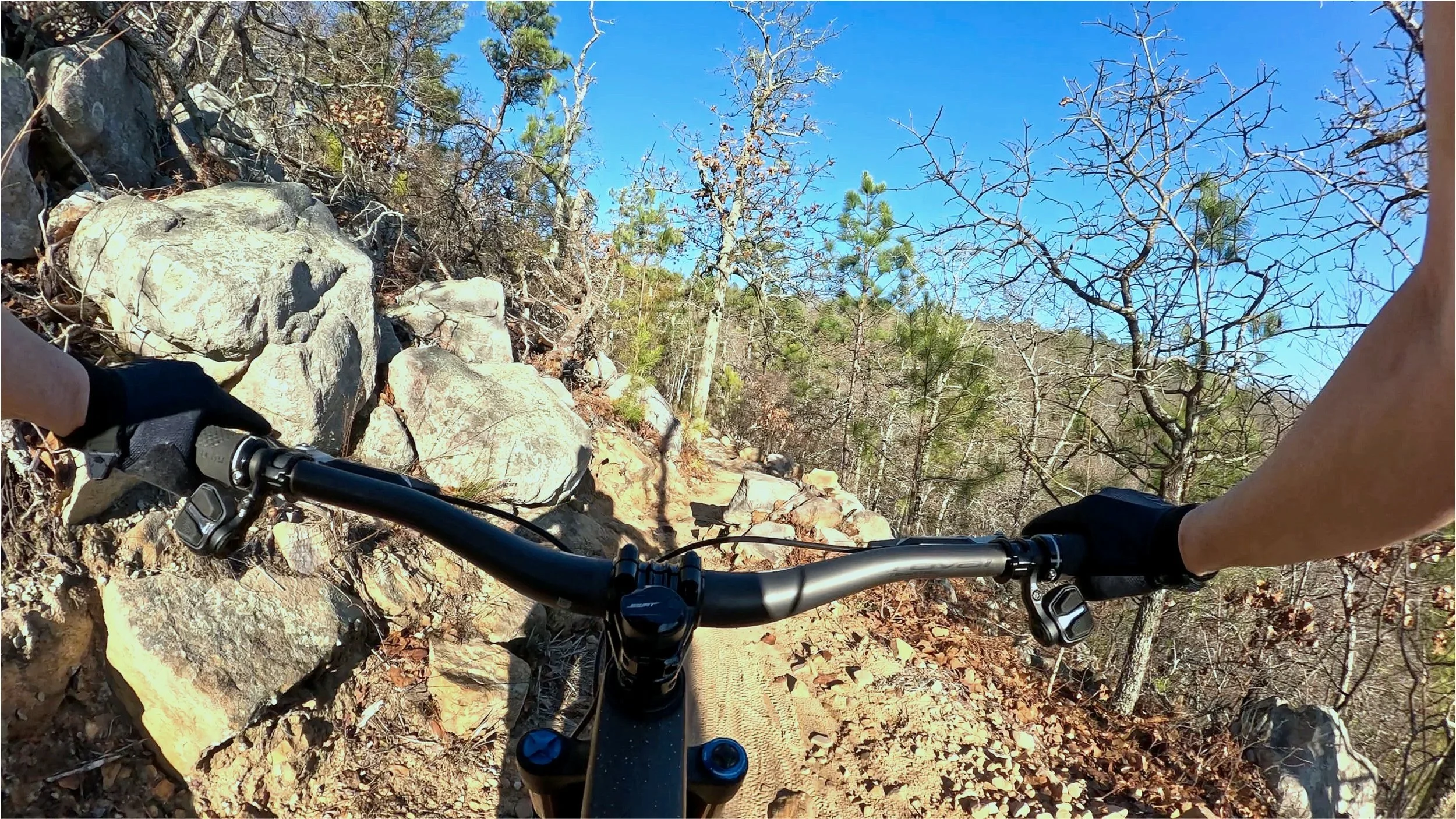
POV riding the rocky, technical sections of Talladega at Coldwater Mountain.
That constant rock presence shapes how the trails ride across all difficulty levels. Line choice matters, pacing matters, and staying engaged is part of the experience. If you’re comfortable riding rock, Coldwater will feel familiar quickly. If not, it’s a place where you’ll learn fast.
Popular Trails at Coldwater Mountain
Coldwater Mountain doesn’t rely on a single standout trail. Its reputation comes from how the system rides as a whole. That said, a handful of trails consistently come up in trip planning and rider conversations:
Tortoise (Green, 2.7 miles): Primary climbing route with sustained elevation and consistently rocky tread. A key access trail for much of the upper system.
Hare (Green, 1.8 miles): Fast downhill flow with berms, tabletops, rollovers, and jump lines. Rides much quicker than its green rating suggests.
Talladega (Blue, ~2 miles): Chunky, rock-forward trail that rewards line choice and steady focus. One of the more technical-feeling blues in the system.
Goldilocks (Blue, ~1–1.5 miles): Smooth rhythm and approachable flow near the Coldwater Trailhead, often recommended for first-time visitors entering from that side.
Bomb Dog (Blue, ~5 miles): One of the longest and most talked-about trails in the system, known for sustained riding with flow, speed, and varied terrain rather than a short downhill burst.
Chilhowee (Blue, ~4.8–5 miles): A long, rolling trail that functions as a key connector in many popular loops. Less flashy than some descents, but one of the most frequently ridden trails due to how well it links the system together.
These trails are rarely ridden in isolation. Most rides at Coldwater are built by linking climbs, connectors, and long descents, and how the trails connect is a big part of what makes the system ride so well.
Coldwater also has two gravity trails at the Coldwater Trailhead — one green and one blue — explicitly built for downhill riding and lap-style runs rather than long pedal loops.
Beginner Riding at Coldwater Mountain
Coldwater Mountain is not particularly beginner-friendly overall. The rocky terrain, sustained climbs, and trail length can feel overwhelming if you’re brand new to mountain biking. That said, there is a set of trails that offers a solid introduction while still delivering quality riding and real mileage.
For true beginners, I recommend starting with what I like to call the Three Bears: Baby Bear, Mama Bear, and Papa Bear. These trails are more forgiving than much of the rest of the system, with smoother tread and manageable features, while still giving you a sense of how Coldwater’s trails connect and flow.
If You Want a Real Challenge: Gaza
Gaza is a black-diamond trail and one of the most technically demanding machine-built trails in the system. But Coldwater’s upper limit doesn’t stop there.
Two double black diamond trails — The PIP and Jordies — were hand-built and are steeper, more off-camber, and more physically and mentally demanding than anything else on the mountain. These trails offer a level of challenge beyond typical machine-built riding at Coldwater and are best suited to riders with advanced technical skills, comfort on steep terrain, and strong line selection.
Events and Regional Impact
NEABA has also helped bring major riding events to Coldwater Mountain, including the Leadville Qualifier Race promoted by Life Time Fitness — the largest event held on the mountain to date. Events like this are helping put Coldwater on the national riding map while bringing significant economic and community impact to the area.
Where to Stay: Coldwater Cabins and Camp
One of the easiest places to stay while riding Coldwater Mountain is Coldwater Camp and Cabins. Located directly at the Anniston Trailhead, it’s a true ride-in, ride-out setup—similar to a ski-in, ski-out experience. You can roll straight from camp onto the trails and finish your ride back to where you’re staying, making early starts, midday breaks, and post-ride downtime simple. You can make a reservation directly through Coldwater Cabins and Camp’s website.
Final Thoughts on Coldwater Mountain
Coldwater Mountain is a trail system that rewards time and repetition. The rocky terrain, sustained climbs, and long trail connections make it feel bigger and more demanding than the mileage alone suggests. It isn’t built around quick laps or easy wins—it asks you to stay engaged and ride with intention.
From greens through blues—and all the way up to Gaza—the terrain carries a consistent character. The trails are designed to work together rather than compete for attention, and each ride builds on the last. The more time you spend here, the more the network makes sense.
Coldwater isn’t a one-and-done destination. It’s the kind of place you come back to, ride each time differently, and gradually unlock as you learn the terrain. I’ll be back again this upcoming weekend.
Michele Underwood writes Overland Girl, where she shares gear she uses on real trips—from the Northwoods of Wisconsin to the Ozarks. She values quality and craftsmanship in everything she buys—from outdoor gear to everyday clothes and furniture. Her choices may seem expensive to some, but she believes in buying less and buying better. Longevity matters, both in terms of function and style. Her couch is five years old and still sold at Design Within Reach—that's the kind of timelessness she looks for. Some of the links in this review are affiliate links, which means she may earn a small commission if you buy through them. It doesn’t cost you anything extra, and it helps support her work. She only recommends gear she’d bring herself.